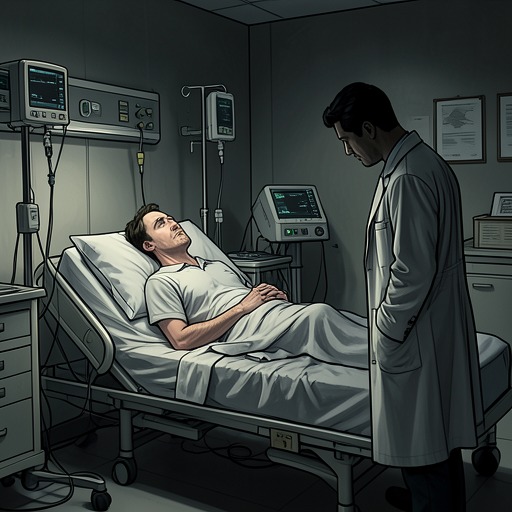
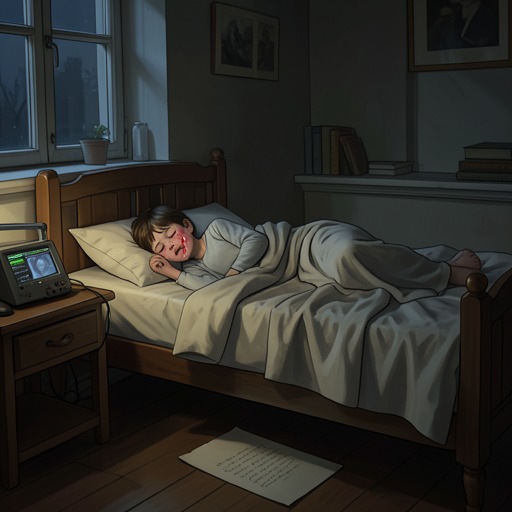
Michael and Hanna first meet while he is ill
The ReaderMichael and Hanna first meet while he is ill, in an episode that makes bodily vulnerability the starting point of their relationship. At fifteen, Michael is weakened by hepatitis; after Hanna helps him when he becomes sick on his way home from school, she walks him home. His mother’s expectation that he return with flowers and thank her leads him back to Hanna’s door during convalescence, where the first encounter begins to acquire a lasting emotional significance.
Illness and First Encounter
Michael’s hepatitis begins in autumn and lasts until spring. As the year grows colder he becomes increasingly weak, and his recovery does not begin until the new year. In January, when the weather turns warm, his mother moves his bed onto the balcony. By February, he is able to venture outside for the first time, retracing the route from the family’s home on Blumenstrasse to Bahnhofstrasse, where he had fallen ill the previous October.
The illness has made ordinary movement difficult. Michael recalls struggling with stairs, losing his appetite, and feeling weak in a way he had never experienced before. On the day Hanna finds him, he is overcome on the street. She takes hold of his arm and leads him through the building entrance to its courtyard, where she washes him and helps him clean the pavement. The assistance is practical and decisive, intervening at a moment when Michael is ashamed and unable to manage the situation alone.
Afterward, Hanna asks where he lives and accompanies him to Blumenstrasse. She carries his schoolbag in one hand and holds his arm with the other. The distance is short, but Michael is still recovering; Hanna’s brisk pace and purposeful manner help him keep up. She says goodbye outside his family’s building, and the encounter ends without any indication that either of them yet understands what it will come to mean.
Return and Emerging Attachment
Michael’s mother calls a doctor that same day, and the doctor diagnoses hepatitis. Michael later tells his mother about Hanna. Taking the account as a reason for a simple act of gratitude, she assumes that once her son is better he will spend his pocket money on flowers, introduce himself, and thank his rescuer. At the end of February, he sets out for Bahnhofstrasse to do so.
A week later, he is at Hanna’s door again. During the intervening days he has tried not to think about her, but illness has left him isolated: his doctor will not yet let him return to school, he is tired of books after months of reading, and visits from friends grow shorter as their daily lives diverge from his. He is supposed to take progressively longer walks without exhausting himself, and he feels he could use more exertion. The return to Hanna’s door takes place within this confined period of convalescence, when ordinary social life remains distant and the encounter has become a focus of attention.
The narrative connects the physical intensity of recovery with the beginnings of attachment. After their first sexual encounter, Michael spends the following night longing for Hanna, dreaming of her, and thinking he can feel her before realizing he is holding a pillow or blanket. He recognizes that he has fallen in love with her. In retrospect, he wonders whether love was a way of repaying a woman who had gone to bed with him, describing a wider impulse to answer sexual intimacy by trying to love the woman and face the world. The memory thus places desire alongside indebtedness rather than presenting the attachment as separate from the circumstances in which it began.
Narrative Significance
The episode establishes a pattern in which Michael’s body and his relationships become linked through acts of care. Hanna first enters his life as the person who responds to his sudden incapacity, cleans up after him, and gets him home. His return is prompted by gratitude, but the later recollection traces how an ordinary obligation leads into a relationship that he experiences as emotionally consuming.
Michael also frames the episode through retrospective narration. He recalls his illness not only as a diagnosis but as a prolonged interruption of school, friendship, and everyday activity; the sickroom becomes a closed world of books, imagination, and restless thought. That setting helps explain why Hanna’s practical intervention and his later visits assume such weight in memory. The first meeting is brief, but it marks the point where convalescence, dependence, gratitude, and desire begin to converge.